


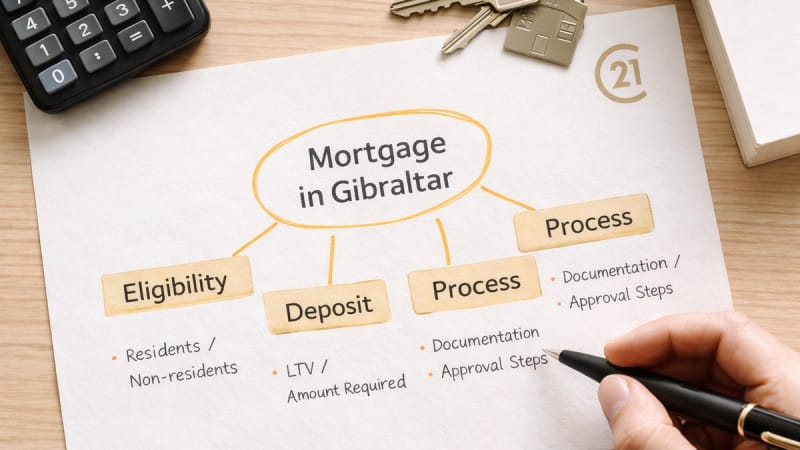
How Mortgages Work in Gibraltar (Eligibility, Deposits & Process)
Mortgage in Gibraltar (2026) — At a glance:
- Gibraltar mortgage availability depends on the lender, your residency status, income profile, property and intended use.
- Expect affordability checks, income and financial-document verification, and normally a lender valuation of the property being purchased.
- Documentation gaps involving income, bank statements or deposit evidence can cause delays, so preparing these early can help.
- Budget for purchase costs such as legal fees, valuation costs and stamp duty in addition to your deposit.
- This guide explains the mortgage process, typical requirements and common practical issues without quoting rates or promising eligibility.
Disclaimer: General information only and not financial, legal or tax advice. Mortgage availability, eligibility, deposit requirements and product terms vary by lender, borrower profile and property type. Always confirm current criteria directly with the relevant lender and obtain professional advice where appropriate.
Contents
Obtaining a mortgage in Gibraltar follows many familiar principles: lenders assess the borrower, the proposed funding and the property being purchased. However, Gibraltar is a relatively small lending market, and criteria can differ considerably between lenders, applicants and property types.
Starting the mortgage conversation early can help you understand your likely budget, documentation requirements and any lender-specific property criteria before you commit to a purchase.
Understanding the Gibraltar mortgage landscape
Gibraltar has a relatively small lending market. When assessing an application, lenders may consider factors including:
- Affordability: income, employment or business income, existing financial commitments and the ability to maintain repayments.
- Applicant profile: residency, employment status, income sources, credit history and other circumstances relevant to the lender's criteria.
- Property suitability: the property's value, tenure, condition, intended use and suitability as lending security.
- Documentation: evidence supporting income, assets, deposit and other information required by the lender.
For this reason, many buyers speak to a lender or mortgage adviser before making an offer. An early indication of affordability does not guarantee a later mortgage offer, but it can help establish a realistic purchase budget.
A mortgage is only one part of the transaction. If you are planning the purchase from the beginning, see our step-by-step guide to buying property in Gibraltar, covering eligibility, property search, offers, financing, legal checks and completion.
Who can get a mortgage in Gibraltar?
Eligibility varies between lenders and mortgage products. Applicants may include:
- Gibraltar residents with suitable and verifiable income.
- Self-employed applicants who can provide the financial records required by the lender.
- Property investors and buy-to-let buyers, subject to the lender's investment-property and affordability criteria.
- Non-resident or overseas buyers where a lender or other financing provider is prepared to consider the applicant and transaction.
Important: Non-resident mortgage availability should never be assumed. Some Gibraltar mortgage providers restrict particular products to residents, while other financing options may apply different criteria. Always establish eligibility directly with the lender or an appropriately qualified adviser before relying on finance for a purchase.
Deposit, LTV and affordability
Mortgage lending is generally assessed using both loan-to-value (LTV) and affordability. There is no single deposit percentage that applies to every Gibraltar buyer.
- Loan-to-value: the maximum proportion of the property's value that a lender is prepared to finance depends on its current lending criteria and the application.
- Deposit: the amount required can vary according to the borrower, property, residency, intended use and mortgage product.
- Affordability: lenders assess whether repayments are sustainable after taking account of income and existing financial commitments.
- Property valuation: the lender will normally require a valuation before confirming that the property is acceptable as security.
Your deposit should not be confused with your total cash requirement. Buyers should also allow for legal fees, valuation costs, stamp duty and other transaction expenses.
For the current stamp duty bands and worked examples, see our guide to Gibraltar stamp duty rates.
Documents you may need for a Gibraltar mortgage
Exact requirements vary by lender and applicant, but a mortgage application may require documents covering:
- Identity and address: passport or other identification, proof of residential address and relevant residency information.
- Employment and income: payslips, employment contracts, tax documentation or other evidence of earnings.
- Self-employment or business income: accounts, tax records and other financial information requested by the lender.
- Bank statements: covering the period required by the lender.
- Deposit evidence: evidence showing the funds available towards the purchase.
- Existing commitments: information about loans, mortgages, credit and other financial liabilities where requested.
- Property information: agreed purchase price and other property or transaction details needed for the application and valuation.
Mortgage documentation and anti-money-laundering requirements can overlap, but they are not the same thing. If your deposit involves third-party funds, overseas transfers or multiple funding sources, you may be asked for additional information or supporting evidence depending on the lender's and other regulated parties' requirements and risk assessments.
For the distinction between proof of funds, source of funds and source of wealth, see our guide to AML, KYC and source-of-funds checks.
Step-by-step mortgage process in Gibraltar
Step 1 — Establish your budget and deposit
Before viewing seriously, establish a realistic purchase budget based on your available deposit, comfortable monthly repayments and the additional costs of purchasing.
Remember that the maximum amount a lender may be prepared to advance is not necessarily the amount you should borrow.
Step 2 — Speak to lenders or a mortgage adviser early
Early discussions can help establish whether your circumstances fit a lender's criteria and what documents will be required.
Depending on the provider, you may also be able to obtain an initial affordability assessment or agreement in principle. This is useful for planning, but it is not the same as a formal mortgage offer and will normally remain subject to further underwriting, documentation and the property being acceptable to the lender.
Step 3 — Find a property and agree the purchase terms
Once you have identified a suitable property and agreed terms with the seller, the formal mortgage application can proceed using the details of the proposed purchase.
Step 4 — Submit the formal mortgage application
The lender will request the application information and supporting documents required for your circumstances.
Missing or inconsistent bank statements, income evidence or deposit documentation can delay this stage, so it is worth preparing the requested records carefully and responding promptly to follow-up questions.
Step 5 — Property valuation and underwriting
The lender will normally arrange a valuation of the property and assess the application through its underwriting process.
The lender may ask further questions about your income, financial commitments, deposit or other aspects of the application before reaching a decision.
A lender's mortgage valuation is primarily undertaken for lending purposes. It should not automatically be treated as a substitute for any independent survey or other inspection a buyer may choose to commission.
Step 6 — Mortgage offer
If the application and property satisfy the lender's requirements, a formal mortgage offer may be issued. This will set out the loan terms and any conditions that need to be met.
You and your solicitor should ensure that the mortgage conditions are understood and dealt with as part of the wider purchase process.
Step 7 — Conveyancing and completion
Your Gibraltar solicitor deals with the legal conveyancing process, which can include examination of title or lease documentation, contractual matters and other relevant legal checks.
These checks are separate from the lender's mortgage valuation and underwriting. Our guide to property due diligence in Gibraltar explains the legal and property-review stage in more detail.
Once the necessary legal, mortgage and transaction requirements have been satisfied, the purchase can proceed to completion and the mortgage funds can be released in accordance with the lender's and solicitor's arrangements.
Common mortgage types
The products available vary by lender and can change over time. Mortgage structures encountered in the Gibraltar market may include:
- Fixed-rate mortgages: the interest rate is fixed for an agreed period, providing greater certainty over repayments during that period.
- Variable-rate mortgages: the interest rate can change in accordance with the terms of the mortgage.
- Interest-only mortgages: where available and appropriate, monthly payments may cover interest rather than repaying the capital during the interest-only period. A satisfactory repayment strategy will normally be required.
- Buy-to-let mortgages: financing intended for qualifying investment properties, subject to the lender's applicable criteria.
Mortgage product availability, rates, fees, eligibility and lending criteria can change. Buyers should compare the current terms applicable to their circumstances rather than relying on a generic idea of the “best mortgage”.
Banks and lenders in Gibraltar
Gibraltar has a relatively small mortgage market. Providers currently active in Gibraltar mortgage lending include:
- Gibraltar International Bank
- NatWest International
- Trusted Novus Bank
Other lenders, private banking arrangements or financing routes may also be available depending on the applicant, transaction and current lending appetite.
Important: The inclusion of a lender on this page is for general information only and does not constitute a recommendation or endorsement by CENTURY 21 Gibraltar. Product availability, residency requirements, loan-to-value limits, rates and underwriting criteria can change.
Always confirm current lending criteria directly with the lender or obtain appropriate independent mortgage or financial advice.
Common mortgage pitfalls and how to avoid them
- Assuming one deposit percentage applies to everyone: LTV and deposit requirements vary, so establish the position for your circumstances early.
- Assuming non-resident finance will be available: lender residency requirements differ. Confirm eligibility before depending on mortgage finance for the purchase.
- Incomplete documentation: missing bank-statement pages, inconsistent income evidence or an unclear deposit trail can lead to further questions and delays.
- Starting the mortgage process too late: discussing finance before committing to a property can help identify potential issues earlier.
- Forgetting purchase costs: the deposit is not the only cash required. Allow separately for stamp duty, legal fees, valuation costs and other applicable expenses.
- Over-stretching affordability: consider what repayment is sustainable for you rather than focusing solely on the maximum amount a lender might approve.
- Foreign-currency income: where income and mortgage repayments are in different currencies, exchange-rate movements and the lender's foreign-income policy may affect the application.
- Assuming mortgage valuation equals property due diligence: the lender's valuation and your solicitor's legal checks serve different purposes.
For a broader breakdown of the money required beyond the deposit, see our guide to Gibraltar property buying costs and ongoing ownership expenses.
Gibraltar Mortgage FAQs
Can non-residents get a mortgage in Gibraltar?
Mortgage availability for non-residents varies. Some Gibraltar mortgage providers restrict particular products according to residency, while other lenders or financing routes may consider overseas applicants. A non-resident buyer should therefore establish eligibility directly with a lender or appropriately qualified adviser before relying on mortgage finance.
How long does a Gibraltar mortgage approval take?
There is no universal approval period. Timing depends on the lender, the applicant, the property and how quickly the required information can be verified. Incomplete documentation, complex income or additional enquiries can extend the process.
What deposit do I need for a mortgage in Gibraltar?
There is no single deposit requirement for all Gibraltar mortgages. The amount can depend on the lender's current LTV policy, your residency and financial profile, the property and whether it will be your home or an investment.
Is a property valuation required for a Gibraltar mortgage?
A lender will normally require an acceptable valuation of the property before completing mortgage approval. The valuation helps the lender assess the property as security and determine the applicable loan-to-value position.
Do Gibraltar mortgages work like UK mortgages?
There are similarities in the concepts of affordability, loan-to-value, valuation, underwriting and solicitor-led conveyancing, but Gibraltar has its own lending market and individual lenders apply their own eligibility and property criteria.
Can I get a mortgage for a buy-to-let property in Gibraltar?
Buy-to-let mortgage products may be available, but the lending criteria can differ from those for an owner-occupied home. Deposit requirements, affordability assessment, rental considerations and other conditions depend on the lender and product.
What if my mortgage deposit comes from overseas or multiple sources?
You may be asked for additional information or supporting evidence depending on the funding arrangements and the requirements of the lender and other regulated parties. The important distinction between proof of funds, source of funds and source of wealth is explained in our AML, KYC and source-of-funds guide.
Do I need mortgage pre-approval before viewing properties?
Not necessarily. However, discussing affordability and eligibility with a lender or mortgage adviser before making a serious offer can help establish a realistic budget and identify possible financing issues earlier.
Planning to buy with a mortgage? CENTURY 21 Gibraltar can help you understand how the property search and mortgage process fit together, while your lender or mortgage adviser determines the finance available to you.
For the complete transaction from preparation through to completion, see our guide to buying property in Gibraltar.
Disclaimer: General information only and not financial, legal or tax advice. Mortgage availability, eligibility, deposit requirements, rates and product terms vary by lender, borrower profile and property type. Always confirm current criteria directly with the relevant lender and obtain professional advice where appropriate.


